Open-Cell Spray Foam Insulation
A lighter, more budget-friendly foam that expands to fill every stud and rafter cavity — a strong fit for interior walls, attic-floor coverage, and any space where sound-dampening matters as much as R-value.
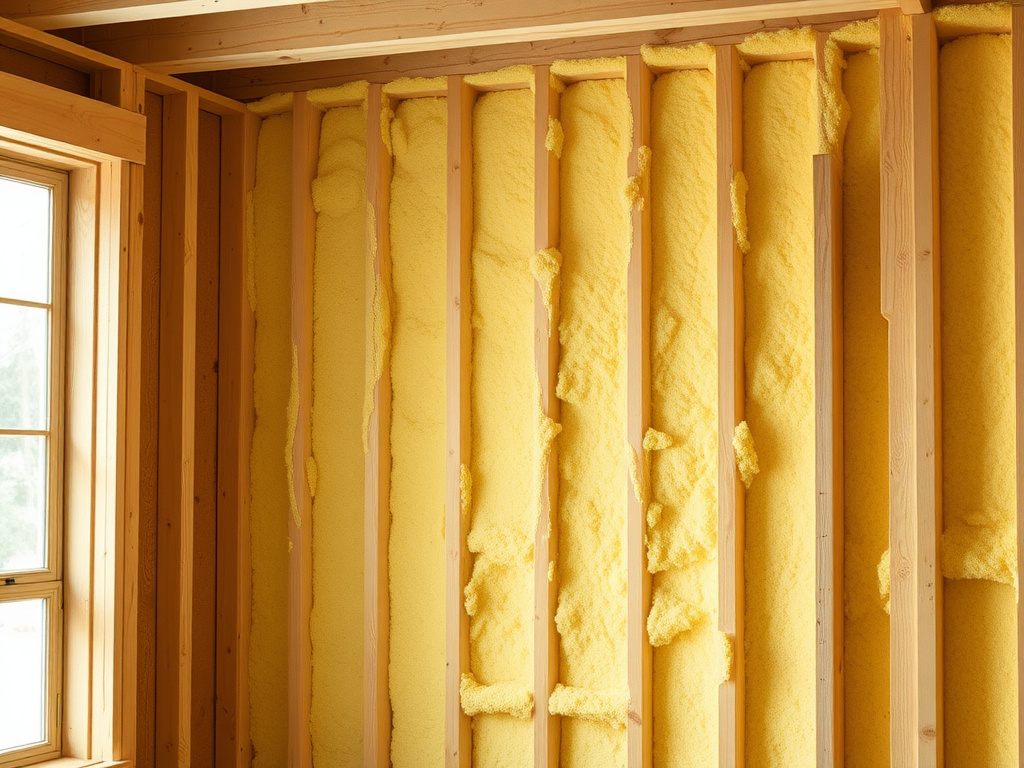
Open-cell spray foam expands dramatically after application, filling irregular gaps around wiring, plumbing, and framing that fiberglass batts consistently miss, then cures into a continuous air barrier in the same pass. At roughly R-3.5 to R-4 per inch, it doesn't carry the same density or per-inch R-value as closed-cell foam, but it costs less per board foot, which makes full-coverage projects — an entire attic floor, every interior wall — more budget-friendly.
In Littleton's cold, semi-arid Zone 5B climate, open-cell earns its place inside the conditioned envelope, in dry, protected cavities that aren't exposed to below-grade moisture: interior partition walls, attic-floor application in vented attics, and any assembly that stays dry. Its open-cell structure also absorbs sound meaningfully better than closed-cell or batt insulation, which matters for a media room, a home office next to a garage, or an interior wall between bedrooms. It's not the right call for basement walls, rim joists, or any application exposed to ground moisture — we'll walk through exactly which spaces call for open-cell versus closed-cell during your free on-site assessment.
Why homeowners choose it
- Expands to completely fill irregular framing cavities, closing the small gaps around wiring and plumbing that batts always leave behind.
- Air-seals and insulates in a single application, directly addressing the infiltration pathways that let winter cold and summer heat into a home.
- Delivers noticeably better sound dampening than closed-cell foam or batt insulation — a real benefit for interior walls, media rooms, and home offices.
- Costs less per board foot than closed-cell foam, making full-interior or attic-floor coverage more affordable on larger retrofit projects.
- Cures rigid and stable, holding its performance for decades in dry, protected interior cavities.
Where open-cell makes the most sense in a Littleton home
Open-cell isn't the right call for every assembly — it's not a vapor barrier and isn't recommended for basement walls, rim joists, or exterior-exposed applications where moisture is a factor. But inside the conditioned envelope, in dry, protected cavities, it's an efficient, cost-effective way to insulate and air-seal at the same time.
- Interior walls between rooms with different noise or temperature needs
- Attic floors in vented attics with adequate depth
- Garage-to-living-space shared walls and ceilings (interior side only)
Ideal for
- Interior partition walls where sound dampening matters
- Vented attic-floor coverage where roofline depth isn't a constraint
- Media rooms, home offices, and bedrooms sharing a wall with a garage or mechanical room
- Larger retrofit projects where cost-per-board-foot is a real budget factor
What affects the cost
Open-Cell Foam questions, answered
Open-cell spray foam is lighter and less expensive per board foot, delivering about R-3.5 to R-4 per inch, and works well for interior walls and areas needing sound dampening. Closed-cell spray foam is denser, delivers about R-6 to R-7 per inch, adds structural rigidity plus vapor-retarder performance — advantages that matter more in basements, rim joists, and roofline applications. For most Littleton interior walls and vented attic floors, open-cell is the more cost-effective choice.
Yes, for the right applications — dry, protected interior cavities where moisture exposure isn't a concern. For anything below grade or exposed to ground moisture, like basement walls and rim joists, closed-cell is the standard recommendation instead. We'll assess your specific project and recommend the right material for each application, not one type across the board.
Open-Cell Foam done right, by a local Littleton crew
Open-Cell Foam isn't a commodity — the result depends entirely on how carefully it's planned and installed for your specific home and Littleton's real cold-winter, warm-summer Zone 5B climate. We assess what your house actually needs, prep and air-seal properly, and install to your Zone-5B-appropriate R-value target, so the work delivers the comfort and savings it's supposed to.
We serve Littleton, Highlands Ranch, Centennial, Englewood, Lone Tree, Parker, Castle Rock, and Ken Caryl / Columbine Valley. Every job starts with a free, no-pressure quote.
Just as important, we treat your home like the system it is. Insulation, air sealing, and the rim joist all interact, and getting one right while ignoring the others leaves comfort and savings on the table. When we scope your open-cell foam, we look at how it fits the whole picture — so the finished result performs the way it should, holds up through a genuine Littleton winter and summer, and actually lowers the bills you feel every month.
Free assessment
We evaluate your home and give you a clear, itemized quote.
Expert install
We prep, air seal, and install your open-cell foam to spec — clean and on schedule.
Savings you can feel
A cooler home, lower cooling bills, and honest advice about what your home needs.
Related services
Ready for a free open-cell foam quote?
Tell us about your home and we'll put together a clear, no-pressure spray foam insulation quote — built for Littleton's real winters and real summers.